Exact Mass-Balance Equations for Batch & Continuous Sizing
To size any dryer in dehydrator sizing and selection and dehydration airflow and process specs—apply the dry-matter conservation equation: Finished Dry Weight = Wet Weight × (1 − Initial Moisture) ÷ (1 − Final Moisture).
For example, drying 100 kg of raw apples at 86% moisture (14 kg dry solids) down to 15% final moisture yields 14 ÷ 0.85 = 16.5 kg of dried apple rings and evaporates 83.5 kg of water.
100 kg Finished Dry Product: Required Wet Input & Tray Count
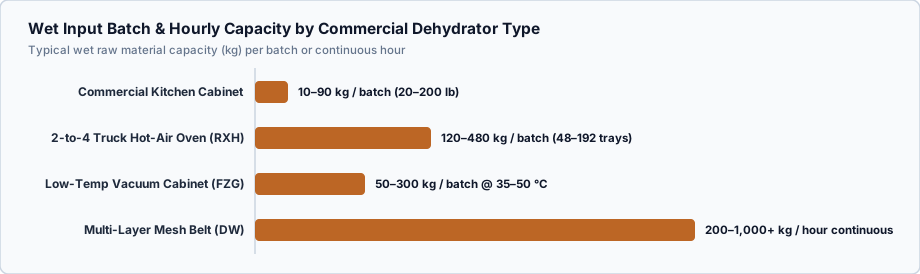
Hardware required to produce 100 kg of finished dried product in a single batch (standard 640 × 460 mm tray @ ~3.0 kg wet load):
| Product Type | Initial -> Final Moisture | Wet Raw Input Needed | Water Evaporated | Trays & Recommended Oven |
|---|---|---|---|---|
| Beef Jerky Strips | 72% -> 25% (<=0.80 Aw) | ~370 kg marinated meat | 270 kg H2O | ~124 trays -> 3-Truck RXH Oven |
| Apple / Mango Chips | 86% -> 14% | ~615 kg sliced fruit | 515 kg H2O | ~205 trays -> 4-Truck RXH or Belt |
| Diced Carrots / Onions | 88% -> 6% | ~780 kg blanched veg | 680 kg H2O | Continuous DW Mesh-Belt Dryer |
| Culinary Leafy Herbs | 85% -> 8% | ~610 kg fresh leaves | 510 kg H2O (@ 1.5 kg/tray) | Continuous Belt or Multi-Truck |
| Baked/Dried Pet Chews | 65% -> 16% | ~240 kg formed chews | 140 kg H2O | ~80 trays -> 2-Truck RXH-II (96 trays) |
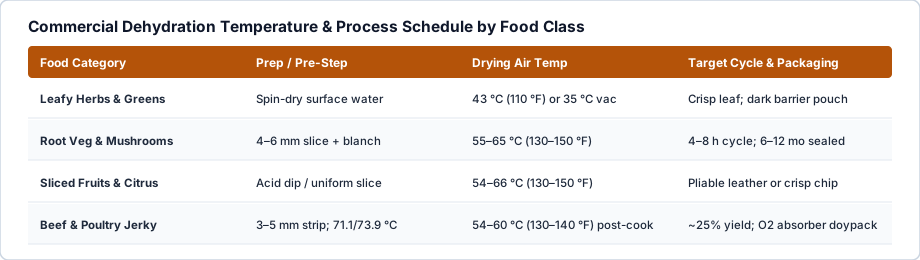
Match your batch schedule to temperatures in our dehydration temperature chart.
Commercial Dehydration Engineering Notes
- Account for Peeling & Core Trim Loss: Apples, pineapples, and onions lose 15–28% raw weight during peeling/coring/slicing before entering the dehydrator—order raw produce accordingly.
- Leafy Herbs Are Volume-Limited: Fluffy basil or mint holds only 1.2–1.8 kg per tray rather than 3.5 kg—size herb cabinets by tray square meters, not weight.
- Two Cycles per 24 Hours: A 9-hour fruit or jerky cycle easily runs two full batches per 24 hours on one 2-truck oven using spare pre-loaded trolleys.
Validate Your Daily Mass Balance
Send your raw crop and target daily finished pouches via Project Brief.
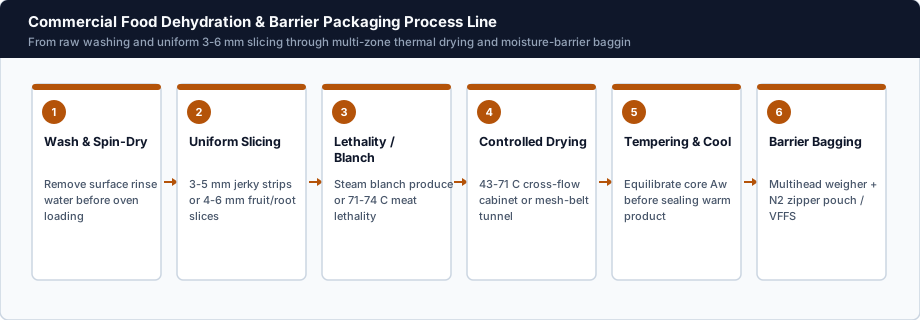
Explore related equipment in Commercial Food Dehydrators, Airflow & Process Specs, or send your wet-to-dry batch targets via Project Brief.
Related Specifications
Further Reference
Request Project Configuration Review
Share layout constraints, architectural drawings, or throughput targets with Commercial Food Dehydrator Technical Group.
Size My Dehydrator