Why Water Activity (Aw) and Wet-Bulb Humidity Govern Shelf Stability
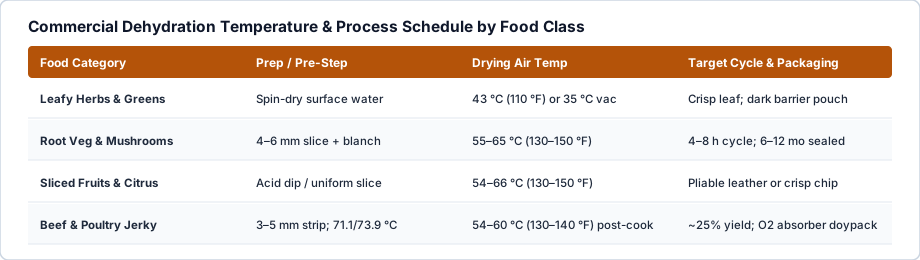
Commercial dehydration is not simply baking food in a dry box—it is simultaneous heat transfer (evaporating bound water) and mass transfer (sweeping saturated boundary-layer vapor away at 1.5–3.0 m/s air velocity). Across commercial food dehydrators, microbial shelf stability is verified by water activity (Aw) rather than weight loss alone: vegetables and herbs dry below 0.55–0.60 Aw, dried fruits target 0.60–0.65 Aw, and shelf-stable jerky targets <=0.80–0.85 Aw after thermal lethality.
Energy architecture—direct electric resistance, closed-loop heat-pump dehumidification, or plant steam coils—determines up to 60% of operating cost per kilogram of water evaporated.
Heating & Dehumidification Source Comparison
Compare thermal sources across operating temperature, specific moisture extraction rate (SMER), and facility utilities:
| Thermal / Dehumidification Type | Typical Temp Range | Energy Draw per kg Water Removed | Facility Utility Requirement |
|---|---|---|---|
| Electric Finned-Tube Resistance | 40–120 °C | ~1.1–1.4 kWh / kg H2O | 380V/480V 3-phase (or 220V on small units) |
| Closed-Loop Heat Pump Dryer | 35–75 °C | ~0.35–0.55 kWh / kg H2O (50–65% savings) | 3-phase electric + condensate drain (zero exhaust) |
| Steam Radiator Coil (RXH / Belt) | 50–130 °C | 1.3–1.6 kg steam / kg H2O | Existing 0.2–0.6 MPa plant steam boiler |
| Vacuum + Hot-Water/Steam Shelf | 35–60 °C | Low-temp rapid boil under vacuum | Vacuum pump + warm water/steam circulation |
Run wet-to-dry yield math in our wet-to-dry yield and tray calculator.
Commercial Dehydration Engineering Notes
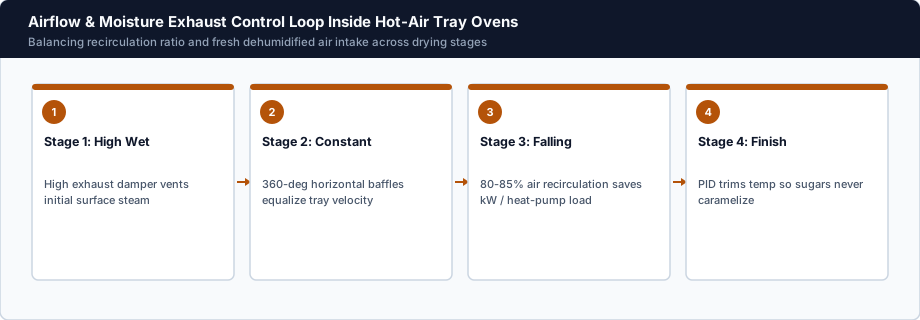
- Constant-Rate vs Falling-Rate Stages: During the first 2–3 hours, free surface water evaporates rapidly—open exhaust dampers wide; during falling-rate diffusion, recirculate 80% of air to save power.
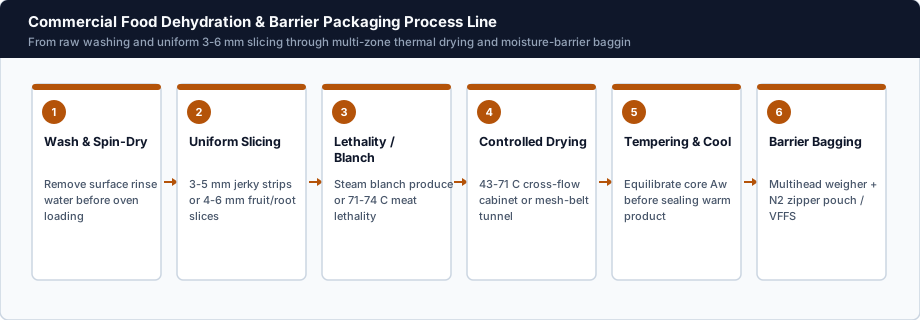
- USDA Meat Lethality Rule: Evaporative cooling keeps raw meat below air temperature until dry—always apply a humid 71.1 °C (beef) or 73.9 °C (poultry) lethality step before low-temp drying.
- Cool Before Barrier Sealing: Sealing 55 °C fruit chips or jerky directly into pouches causes internal headspace condensation and mold; cool below 28 °C in a dry room first.
Match Your Crop Curve to Chamber Controls
Explore crop-specific setups in food dehydration applications and sizing tools in dehydrator sizing and selection.
Discuss your target moisture and daily kg via Project Brief.
Explore related equipment in Commercial Food Dehydrators, Airflow & Process Specs, or send your wet-to-dry batch targets via Project Brief.
In This Section
Further Reference
Request Project Configuration Review
Share layout constraints, architectural drawings, or throughput targets with Commercial Food Dehydrator Technical Group.
Size My Dehydrator