Food-Grade Stainless Construction & Mapped Chamber Uniformity
Thin sheet-metal cabinets with uninsulated doors radiate heat into your kitchen and leave center trays wet while corner trays scorch. Across our commercial food dehydrators range, chambers are built around heavy-gauge SUS304/316L inner liners, high-density rockwool thermal insulation, silicone food-grade door gaskets, and anemometer-balanced horizontal air plenums.
Every cabinet, walk-in trolley oven, and multi-layer belt tunnel undergoes multi-point temperature and air-velocity mapping before shipment.
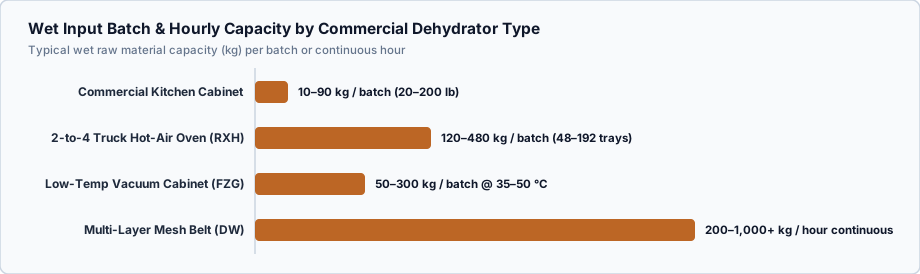
Factory Build Standards & Buyer Deliverables
Core mechanical and electrical specifications across our industrial dryer builds:
| Build Element | Standard Industrial Specification | Operational Benefit |
|---|---|---|
| Contact Trays & Inner Wall | SUS304 (optional SUS316L for high-salt/acid marinades) | Zero rust or pitting against soy/vinegar/citric |
| Chamber Insulation | 50–100 mm high-density rockwool / PU thermal wall | Cool outer skin (<40 °C); minimal kW heat loss |
| Airflow Balancing | Adjustable perforated side plenums (1.5–3.0 m/s) | ±1.5–2.0 °C uniformity without rotating trays |
| Control & Safety | PLC touchscreen, 10-step recipe memory, over-temp cutout | Repeatable HACCP lethality & drying batch logs |
See inspection protocols in our dehydrator sanitation and FAT checklist and full lines on dehydration and packaging lines.
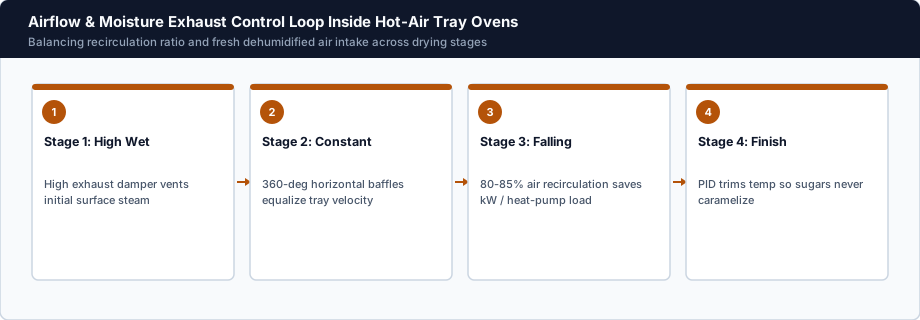
Commercial Dehydration Engineering Notes
- Custom Tray Mesh & Perforation: Choose 2 mm fine mesh for herbs/seeds, 8 mm perforations for sliced fruit, V-hang rods for whole jerky strips, or solid pans for fruit leather/purees.
- Data-Logging USB / Ethernet Port: Export time-temperature-humidity batch curves directly for USDA/FDA/GFSI food safety audits.
- Modular Containerized Belt Sections: Large DW mesh-belt tunnels ship in pre-wired modular 2–3 m frames that bolt together rapidly on your plant floor.
Discuss Custom Chamber Sizing
Request CAD footprints and an itemized quotation via our Project Brief.
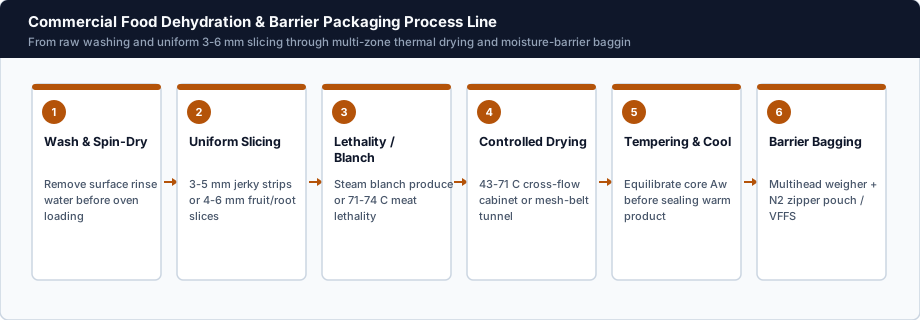
Explore related equipment in Commercial Food Dehydrators, Airflow & Process Specs, or send your wet-to-dry batch targets via Project Brief.
Further Reference
Request Project Configuration Review
Share layout constraints, architectural drawings, or throughput targets with Commercial Food Dehydrator Technical Group.
Size My Dehydrator