Continuous Tonnage & Ultra-Low-Temperature Specialty Platforms
When raw vegetable, fruit, or pet-treat throughput exceeds 2–3 metric tons per day, loading hundreds of individual trays by hand becomes your biggest labor expense. Within commercial food dehydrators, continuous multi-layer mesh-belt tunnels automate feeding, turn product gently between 3 to 5 stacked belts, and discharge cooled dried pieces directly to multihead weighing lines.
Explore continuous tunnels in multi-layer mesh belt dryers and oxygen-free drying in vacuum and fluid-bed food dryers.
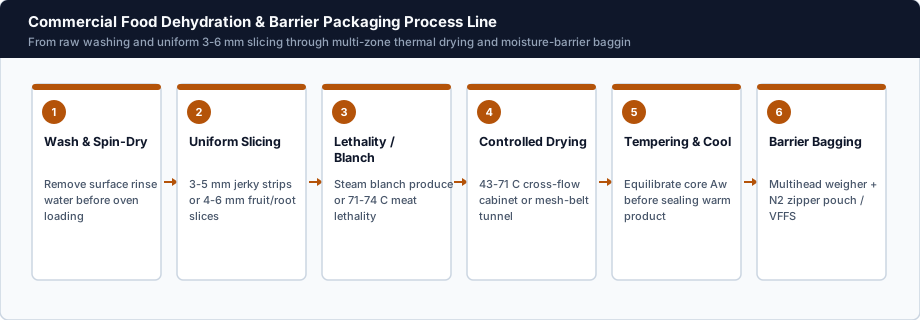
Continuous & Specialty Dryer Comparison
Select between belt, fluidized-bed, and vacuum chambers by particle geometry and oxidation sensitivity:
| Dryer Technology | Material Geometry | Typical Capacity | Key Process Advantage |
|---|---|---|---|
| DW 3–5 Layer Mesh Belt | Slices, strips, cubes, chews (5–50 mm) | 200–1,500+ kg/h | Independent temp/air speed in each belt zone |
| ZLG / GF Fluidized Bed | Free-flowing granules, peas, seeds (0.1–6 mm) | 150–1,000 kg/h | Rapid 15–40 min residence; uniform fluidization |
| FZG / SZG Vacuum Dryer | Pastes, berries, herbs, extracts | 50–300 kg/batch | Boils moisture at 35–50 °C; zero oxidation |
Need smaller multi-SKU batch flexibility? See tray and cabinet dehydrators.
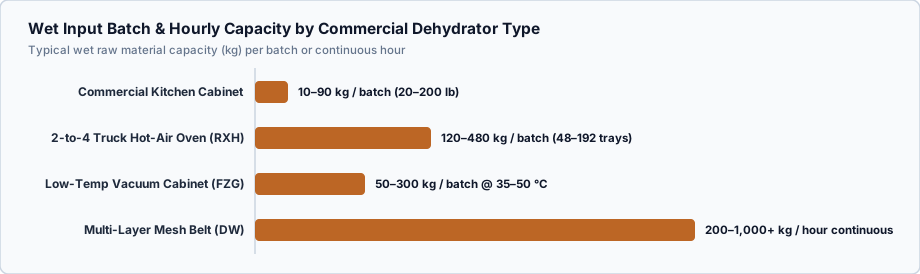
Commercial Dehydration Engineering Notes
- Gentle Inter-Belt Cascading: As slices drop 150 mm from Belt 1 onto Belt 2, pieces flip automatically—exposing fresh wet surfaces and breaking clumps.
- Independent Zone Temperature Profiling: Run higher evaporative heat on top wet belts (70–85 °C) while finishing gently on bottom belts (50–55 °C) plus an ambient cooling section.
- Full Hinged Side Access Doors: Full-length insulated side doors expose belt undersides and fines-catch pans for fast end-of-shift CIP/washdown.
Check Tunnel Length & Utility Load
Review complete upstream/downstream lines on dehydration and packaging lines or start a Project Brief.
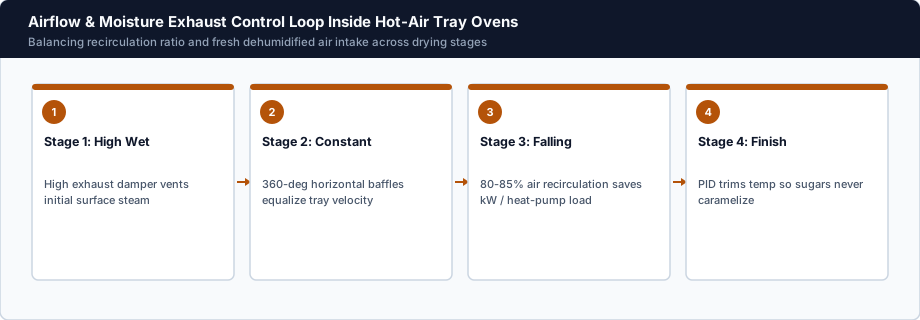
Explore related equipment in Commercial Food Dehydrators, Airflow & Process Specs, or send your wet-to-dry batch targets via Project Brief.
In This Section
Related Specifications
Further Reference
Request Project Configuration Review
Share layout constraints, architectural drawings, or throughput targets with Commercial Food Dehydrator Technical Group.
Size My Dehydrator