Always Size Dryers by Kilograms of Water Evaporated—Not Finished Weight
The #1 sizing mistake new snack and jerky plants make is asking for a ‘100 kg dehydrator’ when they need 100 kg of finished dried apple chips—which actually requires loading 650 kg of wet sliced apples and evaporating 550 kg of water! Built on dehydration airflow and process specs, use our calculators and guides to size thermal capacity right the first time.
Run your numbers in the wet-to-dry yield and tray calculator and crop temperature & airflow chart, then consult commercial food dehydrator price, how to choose a commercial food dehydrator, and our dehydrator sanitation & FAT checklist.
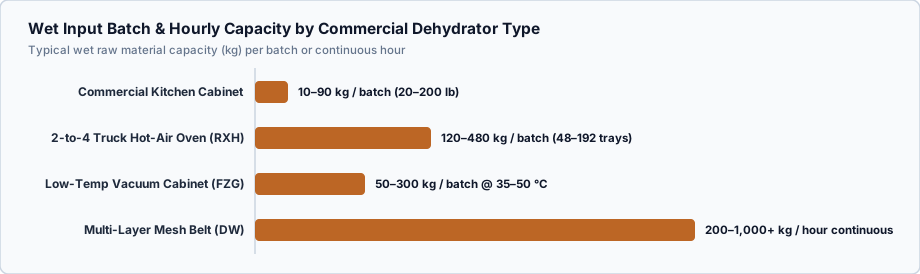
Quick Sizing Conversion Steps
Four equations every processor should check before choosing cabinet vs belt:
| Calculation Step | Formula | Worked Example (50 kg Dry Jerky / Batch) |
|---|---|---|
| 1. Wet Raw Input (kg) | Finished Dry kg × Wet-to-Dry Ratio | 50 kg × 4.0 = 200 kg sliced marinated beef |
| 2. Water to Evaporate (kg) | Wet Input kg − Finished Dry kg | 200 kg − 50 kg = 150 kg H2O removed |
| 3. Tray Count Needed | Wet Input kg ÷ (2.5 to 3.0 kg/tray) | 200 ÷ 2.5 = 80 trays -> 2-Truck RXH-II (96 trays) |
| 4. Heat-Pump vs Electric kWh | Water kg × (0.45 HP vs 1.25 Elec) | ~68 kWh (heat pump) vs ~188 kWh (resistance) |
Compare hardware frames in commercial food dehydrators.
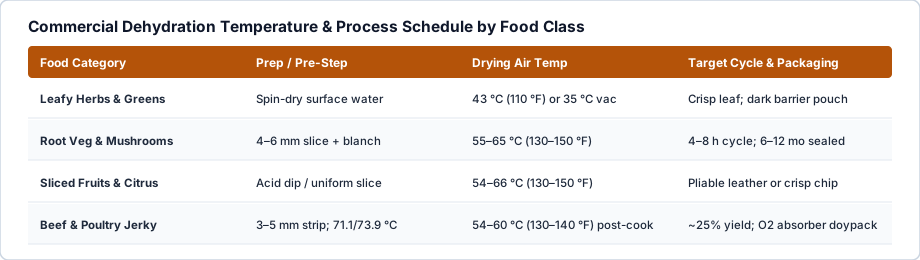
Commercial Dehydration Engineering Notes
- Single-Layer Loading Rule: Overlapping meat strips or fruit slices doubles cycle hours and creates dangerous wet pockets—size tray surface area for a single unstacked layer.
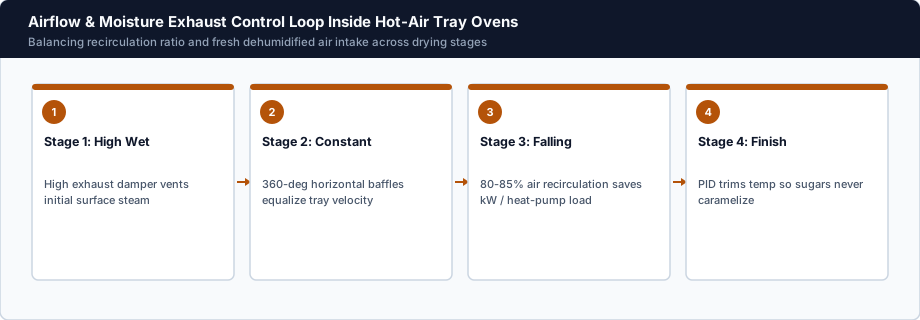
- Check Exhaust Duct Routing: Open-loop electric/steam ovens vent 150+ kg of warm humid vapor per batch; route insulated stainless exhaust ducts directly outdoors.
- Verify 3-Phase Amperage: If your facility lacks 30–45 kW spare 3-phase capacity, closed-loop heat-pump dehydrators cut connected electrical load by more than half.
Get a Custom Mass-Balance Sheet
Share your raw moisture %, target finished kg/day, and plant power via Project Brief.
Explore related equipment in Commercial Food Dehydrators, Airflow & Process Specs, or send your wet-to-dry batch targets via Project Brief.
In This Section
- Wet-to-Dry Yield, Evaporated Water & Tray Count Reference Calculator
- Commercial Dehydration Temperature, Slice Thickness & Water Activity Chart
- Commercial & Industrial Food Dehydrator Price Guide & Operating Cost
- How to Choose a Commercial or Industrial Food Dehydrator
- Factory Acceptance Test (FAT) & Sanitation Checklist for Food Dehydrators
Related Specifications
Further Reference
- Commercial Dehydration Engineering: Airflow, Temperatures & Water Activity
- Wet-to-Dry Yield, Evaporated Water & Tray Count Reference Calculator
- Commercial Dehydration Temperature, Slice Thickness & Water Activity Chart
- Commercial & Industrial Food Dehydrator Price Guide & Operating Cost
- How to Choose a Commercial or Industrial Food Dehydrator
Request Project Configuration Review
Share layout constraints, architectural drawings, or throughput targets with Commercial Food Dehydrator Technical Group.
Size My Dehydrator