Six Questions That Separate Profitable Drying Rooms from Bottlenecks
Choosing a commercial dehydrator by counting shelves without checking fan static pressure, insulation thickness, or wet-bulb humidity control leads to uneven trays and failed shelf-life tests. Within dehydrator sizing and selection and dehydration airflow and process specs, answer these six engineering questions in order.
Whether launching a 50 kg/day craft jerky brand or a 10-ton/day dehydrated onion line, the physics follow the same sequence.
Six-Step Commercial Dehydrator Selection Matrix
Match your operational constraints to hardware specifications:
| Selection Step | Key Metric to Verify | Hardware Decision Rule |
|---|---|---|
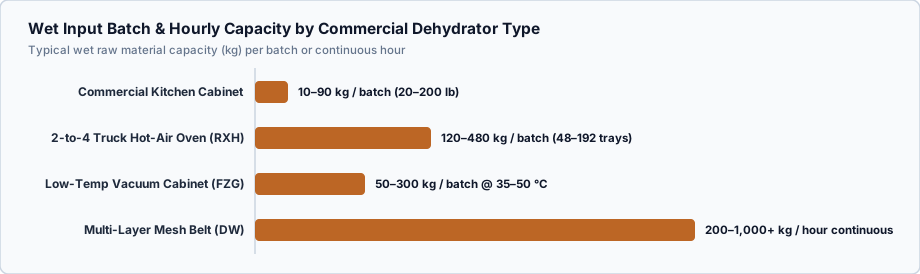
| 1. Daily Evaporated Water | Wet kg in minus finished dry kg out | <500 kg/day = Cabinet/RXH; >2,000 kg/day = Mesh Belt |
| 2. SKU Flavors & Allergens | Single crop vs 8 spiced SKUs/week | Multi-SKU allergens favor isolated batch truck cabinets |
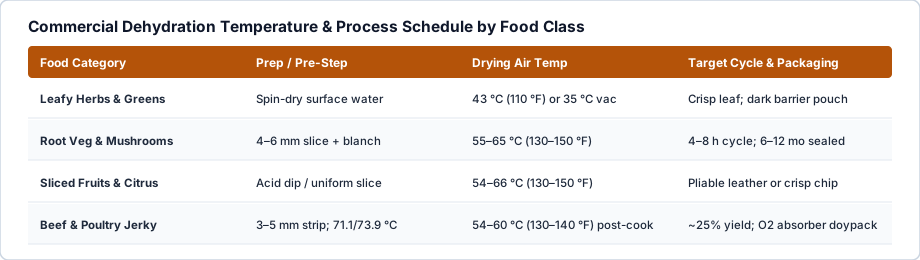
| 3. Thermal Ceiling & Lethality | 43 °C herbs vs 71.1/73.9 °C meat step | Meat requires humidity lethality + core temperature logging |
| 4. Energy Utility Available | 3-phase kW cap vs plant steam boiler | Tight kW cap? Choose closed-loop heat pump; Steam? RXH/DW |
| 5. Tray Surface Geometry | Sticky puree vs fine leaf vs meat strip | Solid pan, 2 mm mesh, PTFE liner, or hanging smoke rods |
| 6. Sanitation & Drain Design | Dry brush vs daily foaming caustic wash | Specify TIG-welded SUS304/316L + sloped floor drain |
Verify chamber uniformity before shipping with our dehydrator sanitation and FAT checklist.
Commercial Dehydration Engineering Notes
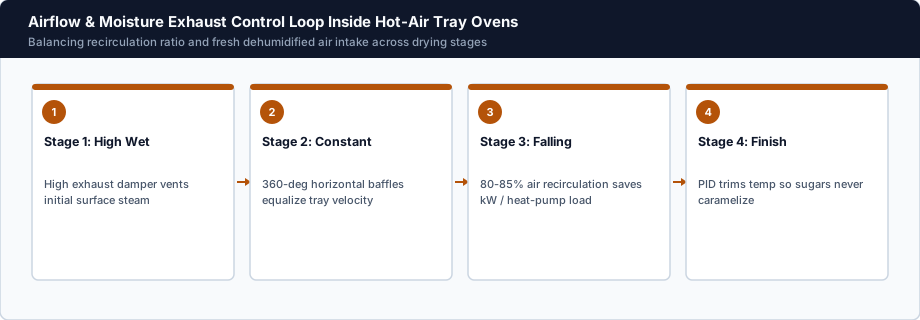
- Never Accept Vertical Bottom-to-Top Household Airflow: Bottom-mounted fans cook lower trays while saturating top trays with wet steam—insist on horizontal cross-flow plenums.
- Check Door Opening & Ceiling Clearances: Walk-in RXH truck ovens and DW belt modules require doorway and forklift rigging clearance verification prior to build.
- Test Water Activity, Not Just Touch: Include a benchtop Aw meter in your QC lab budget so operators end batches scientifically rather than guessing by feel.
Get an Engineer-Reviewed Dryer Recommendation
Share your raw ingredients and daily output targets via Project Brief.
Explore related equipment in Commercial Food Dehydrators, Airflow & Process Specs, or send your wet-to-dry batch targets via Project Brief.
Related Specifications
Further Reference
Request Project Configuration Review
Share layout constraints, architectural drawings, or throughput targets with Commercial Food Dehydrator Technical Group.
Size My Dehydrator