Verifying ±2 °C Uniformity and Sanitary Cleanability Before Delivery
A commercial dryer is only as fast as its coldest, slowest-airflow corner tray—because you cannot unload a trolley until the wettest tray passes water-activity specs. Built under dehydrator sizing and selection and dehydration airflow and process specs, run these five verification tests during Factory Acceptance Testing (FAT) and routine preventive maintenance.
Documented uniformity maps also satisfy third-party GFSI / SQF / HACCP preventive-control audits.
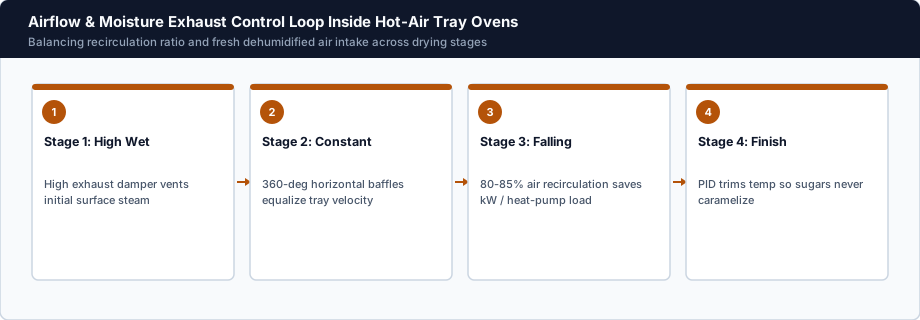
Five-Point Dehydrator FAT & Preventive Care Protocol
Acceptance tolerances and ongoing sanitation checks:
| Verification Check | Test Procedure | Target Acceptance Standard |
|---|---|---|
| 1. 9-Point Thermal Mapping | Log top/mid/bottom × front/center/rear RTDs at 60 °C | Max chamber spread <= ±1.5 °C to ±2.0 °C at steady state |
| 2. Cross-Tray Air Velocity | Hot-wire anemometer across top, middle & bottom tray gaps | Uniform 1.5–3.0 m/s across full vertical plenum height |
| 3. Damper & Heat-Pump Cycle | Step recipe through exhaust / condensate stages | Smooth actuator travel; airtight silicone door seal |
| 4. Meat Probe & USB Log | Ice-bath & boiling-point check on core RTD + export CSV | ±0.3 °C accuracy; unbroken timestamped batch record |
| 5. Washdown Drainage Test | Rinse interior floor and inspect tray-cart casters | Zero standing puddles; food-grade high-temp caster grease |
Review build specifications on commercial food dehydrator manufacturer.
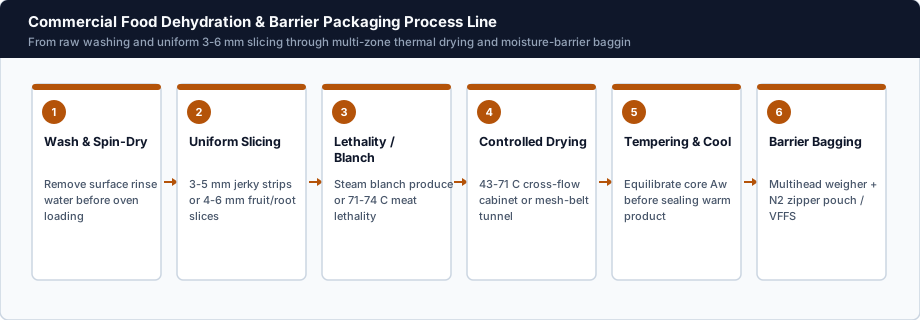
Commercial Dehydration Engineering Notes
- Rotate TrayWash Racks Efficiently: Size a heated soak tank or pass-through tray washer for 640 × 460 mm trays when processing sugary fruits or sticky teriyaki jerky.
- Inspect Heat-Pump Evaporator Fins Monthly: Rinse spice dust or lint off heat-pump evaporator/condenser fins so dehumidification COP stays at peak efficiency.
- Check Door Gasket Compression Annually: Silicone door gaskets flatten after thousands of thermal cycles—keep a spare roll on hand to stop heat leaks.
Plan Your Dehydration Room Commissioning
Submit your project scope via Project Brief.
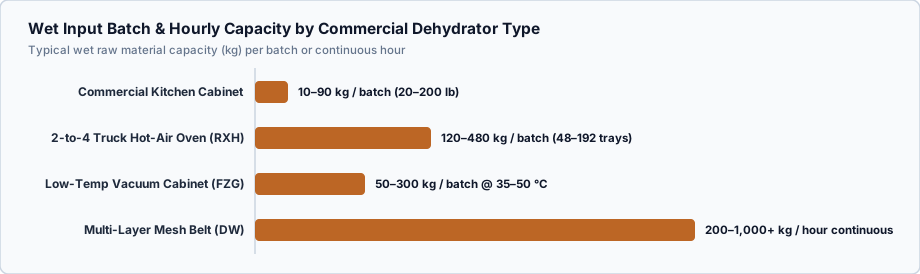
Explore related equipment in Commercial Food Dehydrators, Airflow & Process Specs, or send your wet-to-dry batch targets via Project Brief.
Related Specifications
Further Reference
Request Project Configuration Review
Share layout constraints, architectural drawings, or throughput targets with Commercial Food Dehydrator Technical Group.
Size My Dehydrator