Standardized Commercial Drying Setpoints & Food Safety Targets
Household dehydrator charts often ignore microbial water activity (Aw), enzymatic browning, and USDA meat lethality rules. Grounded in dehydrator sizing and selection and dehydration airflow and process specs, use this commercial setpoint chart to program multi-stage PLC recipes.
Always measure internal core Aw on cooled, equilibrated samples at 25 °C using a calibrated dew-point water activity meter.
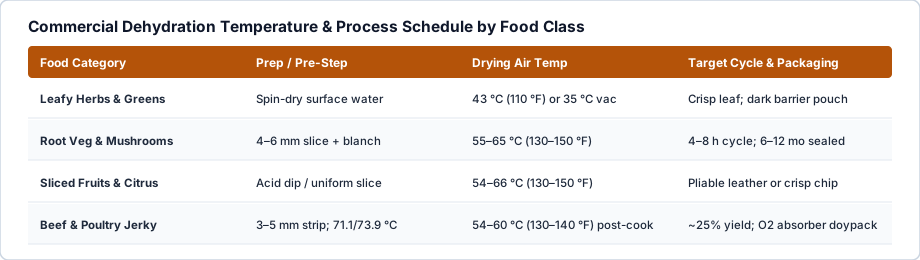
Commercial Food Dehydration Process Parameter Reference
Recommended prep, chamber dry-bulb temperature, cycle window, and finished Aw ceiling:
| Food Item | Slice / Geometry | Pre-Treatment | Chamber Temp (°C / °F) | Typical Cycle | Target Aw |
|---|---|---|---|---|---|
| Whole-Muscle Beef Jerky | 3–5 mm strip | 71.1 °C (160 °F) wet-heat lethality | 55–60 °C (130–140 °F) | 4–7 hours | <= 0.80–0.85 |
| Poultry / Turkey Jerky | 3–5 mm strip | 73.9 °C (165 °F) wet-heat lethality | 57–63 °C (135–145 °F) | 4–7 hours | <= 0.80 |
| Apple / Banana Crisps | 3–5 mm ring/coin | Citric/ascorbic anti-browning dip | 57–65 °C (135–149 °F) | 6–10 hours | <= 0.60 |
| Tomato Halves / Slices | 5–8 mm slice | Light salt or plain skin-puncture | 55–65 °C (130–149 °F) | 7–12 hours | <= 0.62 |
| Carrots, Beets & Roots | 4–6 mm dice/slice | 90–120 sec steam blanch | 60–68 °C (140–155 °F) | 4–7 hours | <= 0.55 |
| Mint, Rosemary & Greens | Whole leaf | Cold wash + centrifugal spin-dry | 40–45 °C (104–113 °F) | 3–5 hours | <= 0.55 |
See full meat-safety oven configurations in jerky, meat, and pet treat dehydrators.
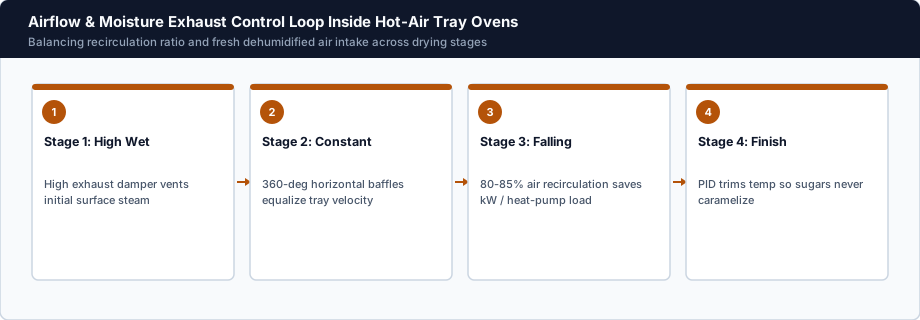
Commercial Dehydration Engineering Notes
- Two-Stage Sugar Control on Fruit: Start high-moisture mangoes or pineapples at 65–68 °C while evaporative cooling keeps flesh cool, then step down to 55 °C so fructose never darkens.
- Vacuum Option for 35 °C Bioactives: Probiotic powders, freeze-sensitive berries, and medicinal extracts run at 35–45 °C under -0.09 MPa vacuum.
- Equilibration (‘Sweating’) Check: Hold dried fruit batches in sealed food-grade totes for 12–24 hours if thick centers need to equalize moisture before retail pouching.
Program Your Multi-Step Recipe
Share your product list via our Project Brief for chamber sizing recommendations.
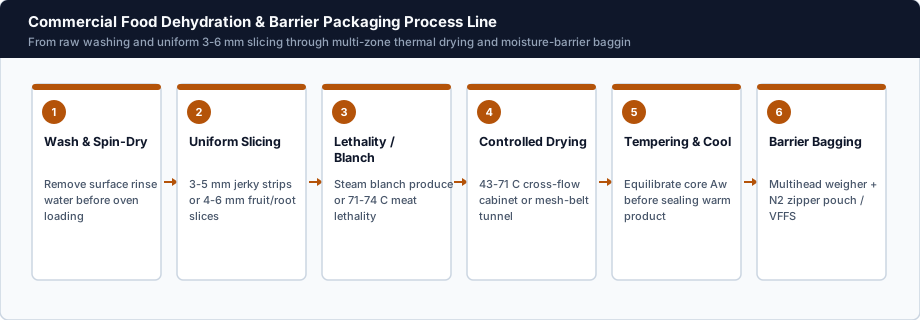
Explore related equipment in Commercial Food Dehydrators, Airflow & Process Specs, or send your wet-to-dry batch targets via Project Brief.
Related Specifications
Further Reference
Request Project Configuration Review
Share layout constraints, architectural drawings, or throughput targets with Commercial Food Dehydrator Technical Group.
Size My Dehydrator