When Hot Air Is Too Harsh—or Granules Need Rapid Fluidization
Certain high-value ingredients cannot tolerate oxygen exposure at 60 °C: berry purees oxidize dark brown, probiotic/enzyme pastes lose activity, and delicate spinach/matcha leaves lose bright chlorophyll. Conversely, uniform 0.1–6 mm food granules, soup bouillon pellets, and seeds dry 5× faster suspended on an upward cushion of air than lying flat on trays. Inside belt and specialty dryers and commercial food dehydrators, FZG vacuum shelf cabinets and ZLG/GF fluidized beds solve these specialized regimes.
Lowering chamber pressure to -0.085 to -0.096 MPa drops water’s boiling point so moisture flashes off cleanly at 35–50 °C in an oxygen-depleted vacuum.
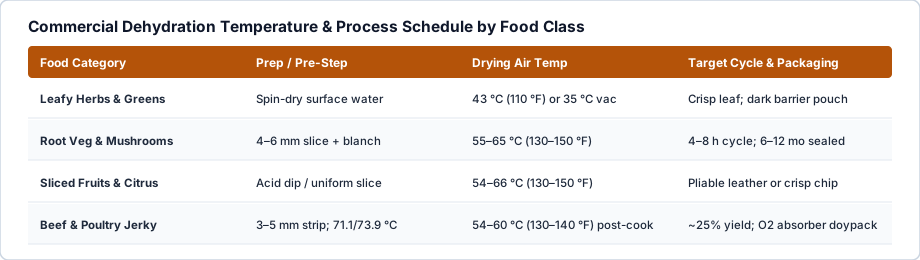
Vacuum Shelf vs Vibrating Fluidized-Bed Specification Matrix
Compare the two specialty industrial drying regimes:
| Parameter | FZG / YZG Vacuum Shelf Dryer | ZLG Vibrating / GF Fluidized-Bed Dryer |
|---|---|---|
| Target Material | Fruit purees, berries, extracts, herbs, sticky pastes | Free-flowing granules, diced veg, peas, crystals (0.1–6 mm) |
| Operating Temperature | 35–55 °C under -0.09 MPa vacuum | 50–110 °C fluidized air cushion + cooling zone |
| Oxygen Exposure | Near-zero O2 prevents lipid/pigment oxidation | Filtered purified air with negative-pressure dust baghouse |
| Puffing / Texture Effect | Creates crisp, porous honeycomb crunch in fruit snacks | Free-flowing non-agglomerated granules |
Compare atmospheric low-temp efficiency in heat-pump cabinet dehydrators.
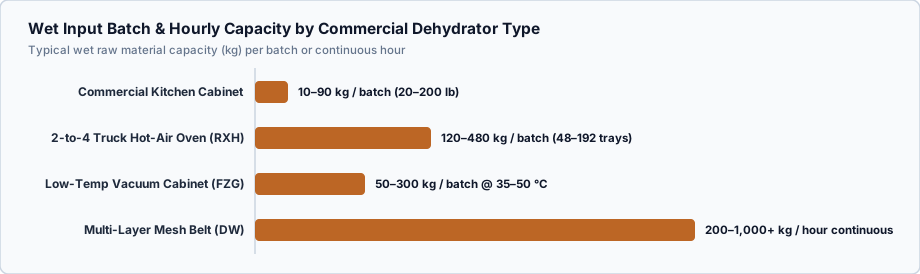
Commercial Dehydration Engineering Notes
- Vacuum-Puffed Fruit Crunch: Controlled vacuum pressure drops expand cellular pores in apple, strawberry, and cheese bites—yielding an oil-free crispy texture.
- Hollow Heated Shelves: Warm water (50–70 °C) or low-pressure steam circulates directly inside hollow stainless vacuum shelves for conductive efficiency.
- Anti-Static Fluid-Bed Bag Filters: GF/ZLG fluidized beds incorporate anti-static filter bags and explosion-relief vents when drying fine carbohydrate or cocoa granules.
Evaluate Vacuum or Fluid-Bed Trials
Describe your heat-sensitive paste, berry, or granule specs via our Project Brief.
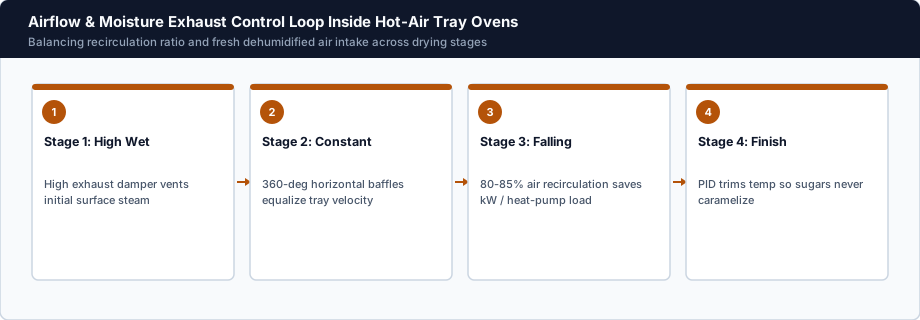
Explore related equipment in Commercial Food Dehydrators, Airflow & Process Specs, or send your wet-to-dry batch targets via Project Brief.
Related Specifications
Further Reference
Request Project Configuration Review
Share layout constraints, architectural drawings, or throughput targets with Commercial Food Dehydrator Technical Group.
Size My Dehydrator