Matching Dryer Architecture to Wet Feed Tonnage & Heat Sensitivity
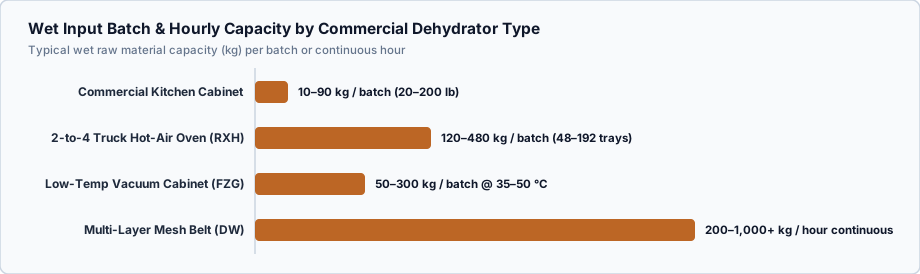
Scaling dehydrated snacks, soup vegetables, culinary herbs, beef jerky, or natural pet chews beyond household plastic racks requires uniform horizontal airflow, food-grade SUS304/316 interiors, and staged humidity exhaust. Commercial food dehydrators span four distinct engineering classes: countertop/reach-in stainless cabinets (10–90 kg wet batch), walk-in RXH hot-air circulating truck ovens (120–500+ kg/batch), DW continuous multi-layer mesh-belt tunnels (200–1,000+ kg/h), and low-temperature vacuum cabinets (35–50 °C).
Choosing the right platform depends on initial moisture content (typically 70–92% in fresh produce and ~75% in raw lean meat), slice geometry, and available plant energy (electric, closed-loop heat pump, steam, or gas).
Commercial Food Dehydrator Platform Matrix
Compare batch and continuous industrial drying platforms by capacity and operating window:
| Dryer Architecture | Wet Input Capacity | Operating Temp Window | Best Product Fit |
|---|---|---|---|
| Reach-In Stainless Cabinet | 10–90 kg / batch (20–200 lb) | 35–80 °C (95–176 °F) | Fruit chips, restaurant prep, jerky startups |
| RXH Hot-Air Truck/Trolley Oven | 120–500 kg / batch (1–4 trucks) | 45–120 °C (PID staged) | Sliced roots, mushrooms, spices, meat treats |
| DW Multi-Layer Mesh Belt Dryer | 200–1,500 kg / hour continuous | 50–110 °C (3–5 zones) | High-tonnage onion, carrot, apple, pet kibble |
| FZG / Vacuum Low-Temp Cabinet | 50–300 kg / batch @ -0.09 MPa | 35–55 °C low-oxygen | Delicate greens, berries, botanical extracts |
Explore batch cabinets in tray and cabinet dehydrators, continuous lines in belt and specialty dryers, and temperature schedules in dehydration airflow and process specs.
Commercial Dehydration Engineering Notes
- 360° Horizontal Cross-Flow Baffles: Horizontal air plenums blow heated air evenly across every tray tier so operators never waste labor rotating racks mid-cycle.
- Eliminate Case-Hardening: Excessive early heat seals outer cell walls into a leathery crust that traps core moisture; multi-stage PID ramps dry slices from inside out.
- Sanitary SUS304 Trays & Cove Corners: Perforated, mesh, or solid stainless steel trays (standard 640 × 460 × 45 mm in industrial RXH trucks) withstand daily caustic washdowns.
Three Inputs Size Your Commercial Dehydrator
Provide raw wet input kg per shift, starting vs target moisture percentage (or water activity Aw), and available energy source.
Submit your product brief via Project Brief or compare sector setups in food dehydration applications.
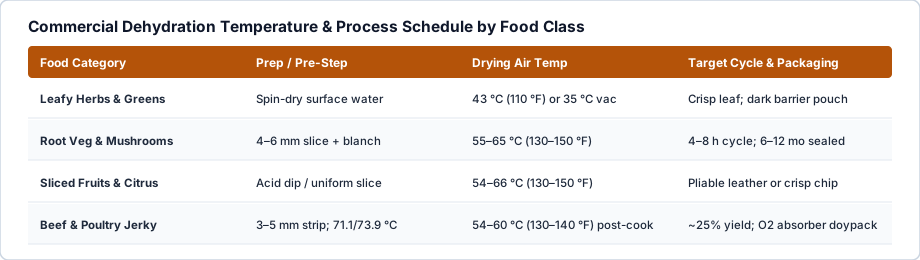
Explore related equipment in Commercial Food Dehydrators, Airflow & Process Specs, or send your wet-to-dry batch targets via Project Brief.
In This Section
Further Reference
Request Project Configuration Review
Share layout constraints, architectural drawings, or throughput targets with Commercial Food Dehydrator Technical Group.
Size My Dehydrator