Stopping Enzymatic Browning, Soggy Trays, and Aroma Loss
Fresh-cut produce arrives at 80–94% moisture and starts oxidizing the minute blades slice cells open. Within food dehydration applications and dehydration airflow and process specs, commercial fruit, vegetable, and herb lines pair targeted pre-treatment (centrifugal spin-drying, citric dips, or steam blanching) with horizontal 360° stainless airflow.
Restaurant/commissary and craft-snack cabinets process 20–200 lbs (9–90 kg) per load, scaling seamlessly to multi-truck heat-pump ovens and continuous DW mesh-belt lines for soup-mix and dried-fruit exporters.
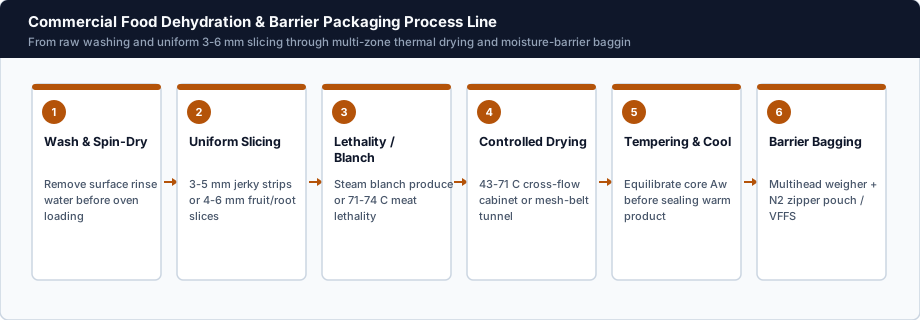
Produce Category Prep & Chamber Configuration Guide
Match pre-processing and tray mesh to produce water content:
| Produce Group | Recommended Pre-Treatment | Tray / Belt Spec | Drying Setpoint & Result |
|---|---|---|---|
| Leafy Herbs & Greens | Wash + 60-sec centrifugal spin-dryer | 2–3 mm fine SUS304 wire mesh | 40–45 °C (104–113 °F); bright emerald leaf |
| Mango, Pineapple & Apple | 4–5 mm rotary slice + organic acid dip | Perforated tray + PTFE non-stick mesh | 57–65 °C staged; chewy ring or crisp chip |
| Onions, Garlic & Leeks | Root/skin peel + 4 mm slice (no blanch) | Dedicated closed-loop heat pump / belt | 55–62 °C; pungent white/gold flake |
| Carrots, Potatoes & Beets | 5 mm dice + 90-sec steam blanch | Perforated truck tray or 4-pass belt | 60–68 °C for 4–6 h; instant soup rehydration |
Check exact moisture yields in our dehydrator yield and tray calculator.
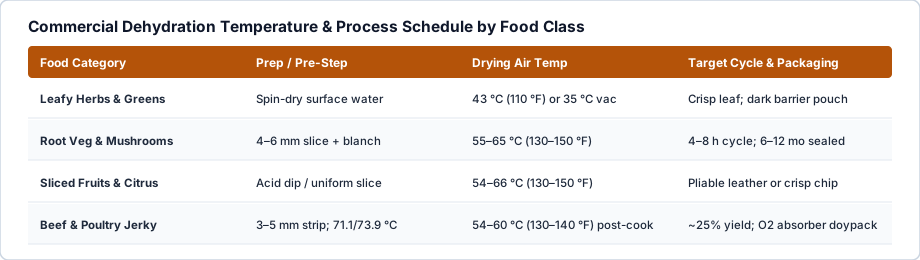
Commercial Dehydration Engineering Notes
- Why Towel-Drying Fails at Scale: Replacing manual towel-drying of washed greens/tomatoes with spin-drying + controlled low-temp dehydration eliminates damp bacterial hotspots and extends prep-kitchen crispness to 5–7 days (or 6–12 months fully dried and sealed).
- Prevent Fruit Sticking with Early Airflow: High air velocity during Hour 1 sets surface sugars lightly so mango cheeks release cleanly from PTFE mesh without tearing.
- Nitrogen-Flushed Stand-Up Pouches: Pack finished kale chips and fruit crisps immediately into metallized PET/PE or foil zipper pouches to block light and humidity.
Size Your Produce Dehydration Line
Send your daily raw produce kg and slice style via our Project Brief.
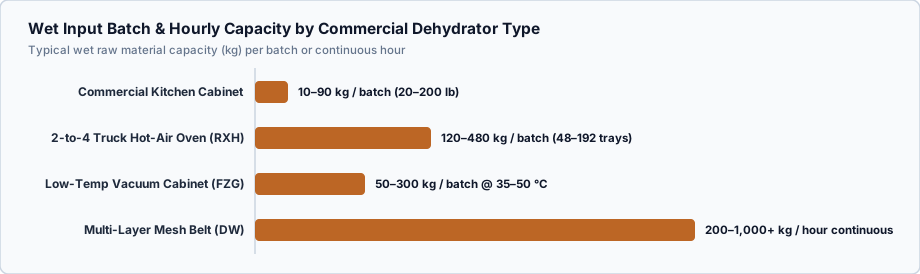
Explore related equipment in Commercial Food Dehydrators, Airflow & Process Specs, or send your wet-to-dry batch targets via Project Brief.
Related Specifications
Further Reference
Request Project Configuration Review
Share layout constraints, architectural drawings, or throughput targets with Commercial Food Dehydrator Technical Group.
Size My Dehydrator