Why Dry-Air Household Dehydrators Fail Commercial Meat Safety Audits
When raw beef, venison, or poultry enters a dry 60 °C (140 °F) dehydrator directly, evaporative cooling keeps meat temperature suppressed while bacteria (Salmonella and E. coli O157:H7) adapt and become heat-resistant—surviving on the finished jerky. Grounded in food dehydration applications and dehydration airflow and process specs, commercial jerky and meat-treat ovens integrate a high-humidity lethality stage (>=71.1 °C / 160 °F internal for beef; >=73.9 °C / 165 °F for poultry/pet treats) before opening dampers for 54–60 °C dehydration.
Slicing tempered lean muscle to a uniform 3–5 mm (0.3–0.5 cm) strip thickness ensures even cure penetration and consistent <=0.80–0.85 Aw across every rack.
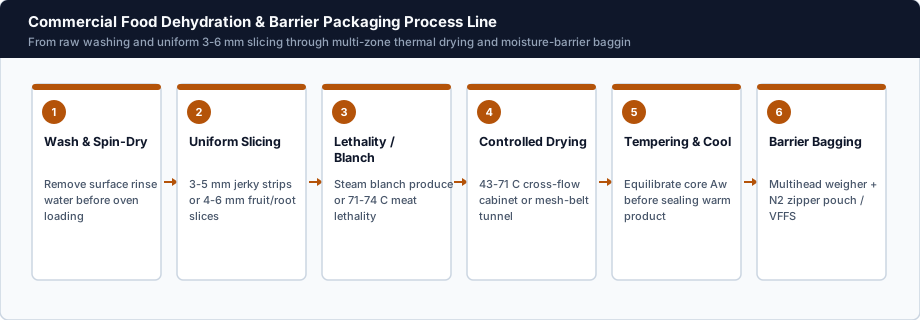
Commercial Jerky & Pet Chew Line Stage Specifications
End-to-end process controls from raw meat trim to oxygen-scavenged retail pouch:
| Process Stage | Hardware & Parameter Spec | Food Safety / Quality Purpose |
|---|---|---|
| 1. Trim & Tempered Slicing | Remove visible fat/sinew; slice 3–5 mm at -2 to +1 °C | Lean fat prevents rancidity; uniform strip dries evenly |
| 2. Vacuum Tumbling | 15–30 min vacuum marinade drum (salt/cure/soy/spices) | Rapid, uniform brine pickup inside muscle fibers |
| 3. Wet-Bulb Lethality Step | Steam/humidity injection to 71.1 °C (beef) / 73.9 °C (poultry) | 5-log pathogen destruction before surface dries |
| 4. Controlled Dehydration | 54–60 °C cross-flow drying + core probe & Aw check | ~25% yield (4 oz per 1 lb raw); pliable non-brittle bite |
| 5. Cool & Barrier Pouching | Cool <26 °C -> 14-Head Dimple Weigher + Zipper Pouch + O2 pack | Prevents pouch sweating & mold; 9–12 mo shelf life |
See integrated weighing and zipper-pouch systems on dehydration and packaging lines.
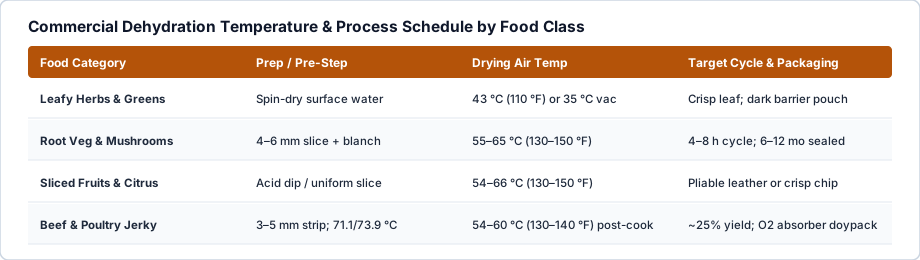
Commercial Dehydration Engineering Notes
- Core Meat Thermocouple & Wet-Bulb Logging: Insert stainless core RTD probes plus chamber wet-bulb sensors so every batch prints a continuous lethality chart for HACCP inspectors.
- SUS316L Option for High-Salt / Acid Marinades: Soy sauce, vinegar, and curing salts attack low-grade steel—specify SUS304/316L interiors with sloped floor drains for foaming caustic washdown.
- Hanging Smoke Sticks vs Flat Mesh Trays: Trolleys accept both flat wire-mesh trays (sliced strips/bites) and V-notched hanging rods (whole tenderloins, sausages, dog chews).
Configure Your Inspected Meat or Pet-Treat Room
Share batch size (kg raw meat), protein type, and regulatory market via Project Brief.
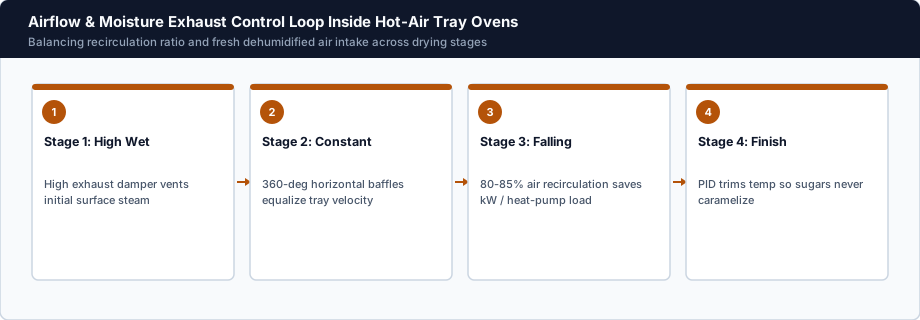
Explore related equipment in Commercial Food Dehydrators, Airflow & Process Specs, or send your wet-to-dry batch targets via Project Brief.
Related Specifications
Further Reference
Request Project Configuration Review
Share layout constraints, architectural drawings, or throughput targets with Commercial Food Dehydrator Technical Group.
Size My Dehydrator